De Beers Child Labour Safeguards Across the Diamond Value Chain
By Britan News
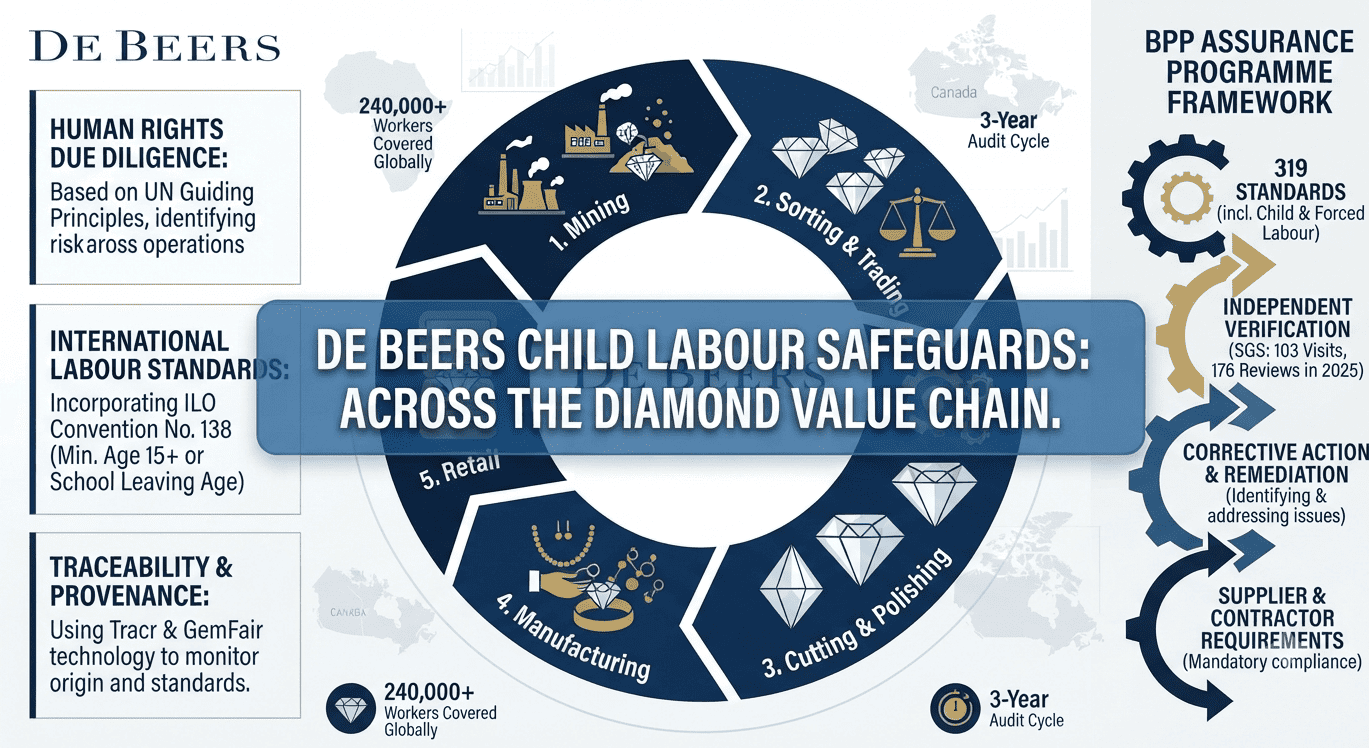
Child labour remains an important human rights issue across global supply chains. De Beers' child labour safeguards form part of a broader approach to responsible sourcing, human rights due diligence and supply-chain monitoring.
In the diamond industry, labour risks can arise at different stages because diamonds may move through mining, sorting, trading, cutting, polishing, manufacturing and retail. Addressing these risks therefore requires more than a single policy. Clear workplace standards, supplier expectations, assessment procedures and remediation processes can provide multiple layers of oversight.
How De Beers Addresses Labour Risks
De Beers uses its Best Practice Principles (BPP) Assurance Programme as a central framework for ethical, social and environmental standards across its operations and relevant business relationships. The programme includes standards covering human rights, labour practices, safety, environmental performance and governance.
The BPP framework is designed to apply beyond directly managed operations. De Beers states that the principles cover its own operations and those doing business with the company, with participating entities independently checked every three years. The current framework contains 319 standards, including requirements concerning child and forced labour.
Child Labour Safeguards and Responsible Sourcing Standards
The 2025 BPP Assurance Programme contains a dedicated child-labour section. It requires participating entities to maintain policies and procedures designed to exclude child labour and to communicate those requirements to relevant personnel and other interested parties.
The requirements also address minimum working age. The 2025 BPP standards state that the minimum age should generally be at least 15 or the age of completion of compulsory schooling, whichever is greater, while hazardous work must not be performed by workers under 18.
The framework also provides for procedures where children are found in the workforce. These include measures intended to support a transition into education or vocational training and to examine the underlying causes that allowed the situation to occur.
Best Practice Principles Across the Value Chain
The BPP programme provides a common framework for businesses participating in the De Beers diamond value chain. It is independently assured and has been operating for two decades.
At the end of 2025, De Beers reported that more than 240,000 workers across 79 countries were covered by the BPPs. The company also reported 103 verification visits and 176 workbook reviews during 2025.
This structure is relevant to De Beers child labour safeguards because labour requirements are incorporated into a wider assurance system rather than treated solely as a statement of principle.
Supplier and Contractor Requirements
Supply-chain controls are important where companies work with independent suppliers, contractors and commercial partners. Labour conditions outside a company's directly operated facilities can be influenced by recruitment practices, workplace management and subcontracting arrangements.
De Beers includes Sightholders and relevant diamond contractors within its BPP framework. Its responsible sourcing approach also covers other business relationships connected with the diamond value chain.
This wider application means that labour standards can be considered at several points between the production of rough diamonds and downstream activities.
Assessments and Independent Verification
A written policy does not by itself demonstrate how a standard operates in practice. For this reason, the BPP system combines participant assessments with independent assurance.
De Beers reported that SGS conducted 176 workbook reviews during 2025, while 103 verification visits were completed. The company also states that all participating entities are independently checked every three years.
Independent verification can involve reviewing documentation, management systems and evidence associated with applicable standards. This creates a process for examining implementation rather than relying entirely on internal declarations.
For these child labour controls, this distinction is important because prevention depends not only on having a written prohibition but also on demonstrating that appropriate procedures are operating within participating businesses.
Corrective Action and Follow-Up
The BPP programme includes a process for addressing issues identified through assessments and verification. De Beers states that identified issues must be addressed and corrective action verified before closure.
This creates a cycle of identification, remediation and follow-up. Depending on the circumstances, corrective measures can involve improving procedures, strengthening training, reviewing records, improving age-verification practices or addressing weaknesses in supplier management.
De Beers reported that a human-related material breach identified in 2024 remained under monitoring during 2025. A subsequent unannounced third-party verification visit confirmed that remediation remained satisfactory, with risk-based monitoring continuing into 2026.
Human Rights Due Diligence
Child labour is also addressed within a broader human rights framework. De Beers states that it applies a rights-based approach and conducts human rights due diligence in line with the United Nations Guiding Principles on Business and Human Rights.
Human rights due diligence involves identifying potential impacts, assessing risks associated with operations and business relationships, taking steps to prevent or mitigate adverse impacts and monitoring the effectiveness of those measures.
This wider approach is relevant because labour risks can intersect with other workplace conditions, including recruitment, working hours, employment practices, subcontracting and worker protections.
Modern Slavery and Labour Policies
De Beers' modern slavery reporting describes its policies concerning human rights, labour rights, non-discrimination and the prohibition of child and forced labour. The company's current UK Modern Slavery Act page identifies these requirements as applying across its diamond value chain.
The company's 2024 statement also described human rights due diligence processes for identifying modern slavery, forced labour and child labour risks. For that reporting period, De Beers stated that no incidents specifically relating to modern slavery, forced labour or child labour were identified through its applicable risk-management programmes.
Such statements should be interpreted according to the reporting period they cover. They describe the company's reported processes and findings for that period rather than establishing that future risks cannot arise.
Workplace Human Rights Standards
De Beers' broader workplace framework connects labour protections with its human rights commitments. Its published policies identify human rights and labour standards as part of the company's wider governance approach.
The 2025 BPP requirements provide more specific operational standards for child labour, including minimum-age requirements, protections for young workers and procedures for responding if a child is identified in the workforce.
This creates a connection between high-level human rights commitments and more detailed workplace controls.
Traceability and Diamond Provenance
Traceability is another element of responsible sourcing, although it serves a different function from labour auditing.
De Beers' Tracr platform is designed to provide digital provenance information for rough diamonds. The company reported that the five millionth rough diamond was scanned on Tracr during 2025.
De Beers has also described traceability as a way of improving supply-chain transparency. Digital records can provide information about a diamond's origin and movement, while labour standards and due diligence address workplace and human rights risks.
The two approaches can therefore operate alongside each other without replacing one another.
Artisanal and Small-Scale Mining
Artisanal and small-scale mining presents different responsible sourcing considerations from large industrial mining operations. De Beers' GemFair initiative is designed to support responsible sourcing from participating artisanal and small-scale diamond miners.
The company has described traceability as particularly relevant in these environments because greater visibility can help identify, monitor and address supply-chain risks. Its GemFair system uses digital tools to support responsible sourcing requirements and assurance processes.
This illustrates how technology, responsible sourcing standards and due diligence can work together when supply-chain conditions are more difficult to monitor directly.
International Labour Standards
International labour standards provide another reference point for corporate requirements. The BPP framework incorporates the principles of ILO Convention No. 138 when defining child labour and establishing minimum-age requirements.
The company's approach therefore connects internal requirements with internationally recognised labour principles.
For multinational supply chains, this can provide a consistent baseline while allowing businesses to account for applicable national laws and school-leaving requirements.
Grievance and Remediation Mechanisms
Audits and assessments are not the only mechanisms for identifying human rights concerns. De Beers states that mechanisms are available for employees, contractors, host-community members and other stakeholders to raise grievances and access remediation where an adverse impact is established.
These channels can provide information that may not emerge during scheduled assessments or document reviews. Their role is particularly relevant to ongoing human rights due diligence because concerns can be raised by people directly connected with an operation or business relationship.
Responsible Sourcing and Transparency
The company's current reporting places responsible sourcing, provenance and human rights within its broader Building Forever sustainability framework. The 2025 Sustainability Report identifies provenance as an ongoing commitment and reports continued activity under the BPP Assurance Programme.
For stakeholders examining these child labour safeguards, these published systems provide several areas to consider: the underlying standards, supplier requirements, assessment procedures, independent assurance, corrective action, grievance mechanisms and reporting.
Together, these mechanisms show how labour standards can be incorporated into different stages of a multinational diamond value chain rather than being addressed through a single isolated policy.
Ongoing Monitoring Across the Diamond Value Chain
These child labour safeguards operate within a continuing management process. Supply chains can change as suppliers, contractors, markets, regulations and operating environments develop.
Regular assessments, supplier engagement, independent verification, grievance mechanisms and corrective action can provide multiple layers of oversight. The BPP programme's requirement for identified issues to be addressed and verified before closure adds a follow-up element to the assurance process.
As responsible sourcing expectations continue to evolve, continued monitoring of labour standards, documentation, supplier relationships and remediation processes remains an important part of supply-chain governance.
